
Weaker sterling coupled with a small drop in capital values since the Brexit vote has led UK commercial property to be discounted by an average of 16% to overseas capital.
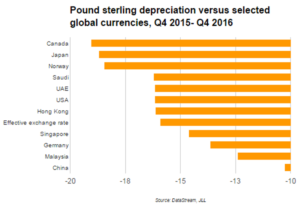
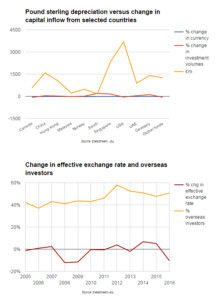
JLL research has found the depreciation has spurred increased investment in the UK from the Middle East and Asia Pacific regions, despite slower capital inflow from the United States and global funds.
As Theresa May triggers Article 50 to start the process of withdrawing from the EU, the findings suggest that if sterling continues at a similar rate, the UK will continue to see sustained interest from Asia Pacific investors.
Although currency movements have not had a strong historic correlation with overall international capital inflow into the UK, they are part of the reason why the market has experienced a recent surge in demand from buyers from the Middle East and Asia Pacific, headlined by Hong Kong and mainland China.
Alistair Meadows, head of UK capital markets at JLL, said: “We continue to see the emergence of Chinese capital globally. Chinese investors now rank just behind US as the second largest source of global cross-border capital and we expect them to have an increasing influence on the UK market.
“Many investors from China and the wider Asia Pacific region come to the UK with different motivations and return aspirations to traditional UK and global investors. They seek diversification and safe haven forms of investment, and attracted to the depth, liquidity and familiarity of the UK market.”
Capital value growth by sector in H2 2016 – IPD Quarterly Index
| Sector | Q3 2016 | Q4 2016 | H2 2016 |
|---|---|---|---|
| Retail Warehouse – Retail Park | -4.5 | -0.1 | -4.6 |
| Office – Inner SE & Eastern | -4.3 | 0.7 | -3.7 |
| Office – Rest of UK | -4.1 | 0.6 | -3.4 |
| Office – City | -3.9 | 1.2 | -2.6 |
| Shopping Centres – In Town | -3.7 | 0.4 | -3.4 |
| Office – Outer SE & Eastern | -3.6 | 1.1 | -2.5 |
| Shop – Rest of UK | -2.6 | 0.5 | -2.1 |
| All Property Types | -2.4 | 1.0 | -1.4 |
| All Property Types | -2.4 | 1.0 | -1.4 |
| Industrial – Rest UK | -1.9 | 1.1 | -0.8 |
| Office – West End | -1.8 | 0.8 | -0.9 |
| Shop – SE & Eastern | -1.7 | 1.4 | -0.3 |
| Industrial – Inner SE & Eastern | -0.8 | 3.6 | 2.8 |
| Industrial – London | 0.1 | 2.7 | 2.9 |
| Shop – Central London | 0.3 | 1.5 | 1.8 |
Overall, overseas investors accounted for 48% of transactional activity in the UK market in 2015 and 51% in 2016, with the increase likely to be due in part to the currency movement, JLL research found. Investment inflows from the Americas (primarily the US) fell from 32% of total overseas investment into the UK to 17% in 2016, with the share of global funds (where the ultimate source of capital is split across multiple countries) also falling. In contrast, Asia Pacific and European (excluding UK) based investors recorded a surge of investment, with the Asia Pacific share rising from 17% to 28%, and Europe from 14% to 23%.
Ben Burston, head of UK office and capital markets research at JLL, said: “For many long-term investors, sterling deprecation provides an added fillip to the investment case, based on their perception that it may appreciate once there is more clarity around Brexit and its economic implications, but it is not a case of one size fits all.
“Private investors have responded to the depreciation more than institutions and global asset managers, and as a result they have become a more important driver of market sentiment and pricing. Despite the triggering of Article 50, as 2017 progresses we expect global funds and institutions to return their focus to the UK, in response to relatively attractive pricing and as more evidence of occupational market resilience comes to light.”